Man versus the Machine
It’s John Henry, still swinging his hammer, still refusing to let a machine beat a man.

Globalism is like a huge mill that grinds everything; the result is an unrecognizable mixture in which no one will retain their personhood, and self-knowledge is lost, Fr. Gregory of Mt. Athos. (Translated from Russian. Athonite Elders, Moscow, 2011.)
Paul Kingsnorth uses similar imagery in his book, Against the Machine (a must-read). He generally says the modern system is a Machine that seeks to uproot and destroy anything of beauty, humanity, and tradition. The Machine intends to tarra-reform the world into a new order.
Depersonalized and soulless, the Machine has been at work. It’s not one particular system of government or economics. To a great extent, it has engulfed all modern systems. The illusion of choice is important, but ultimately, only one thing is advanced.
“The Machine today as an intersection of money power, state power, and increasingly coercive manipulative technologies, which continue an ongoing war against roots and against limits. Its momentum is always forward, and it will not stop until it has conquered the world. To do that, in must raze or transmute many older and less measurable things: rooted human communities, wild nature, human nature, human freedom, beauty, faith and the many deeper values which we all adhere to in some way of another but find it difficult to describe or even to defend. Its modus operandi is the abolition of all borders, boundaries, categories, essences and truths: the uprooting of all previous ways of living in the name of pure individualism and perfect subjectivity. Its endgame is the replacement of nature with technology, in order to facilitate total human control over a totally human world” (Against the Machine, pg 38).
A Mill-Machine grinding everything into nothing. Since it is soulless, it can only destroy. Many are its human servants today. The hub centers of the Machine, the “Western” powers, display their destructive spirit through their absolute love for war and destruction. I hope you, the reader, understand that authentic peace is nowhere in the agenda of the Machine. Thus, the Western powers cheer for war and destruction. It is funded in the billions. This reveals the desolation of their souls, which they have sold to demonic powers. “It is easy to see that one of the most conspicuous results of industrial development is that the engines of war are being constantly perfected and their power of destruction increased at an ominous rate,” Rene Guenon (Crisis of the Modern World, pg. 89).
In his book, Mr. Kingsnorth recounts numerous resistance movements to the Machine, from the Luddites to the Fen Tigers. In some sense, the question is, how do we make ourselves “wrenches in its cogs”? A simple answer, that is many times more complex to apply, is finding the little ways to actively live other than the Machine society instructs us. It’s okay to start small. Every little intentional act of deviation from the Machine is important.
Mr. Kingsnorth is from the British Isles. I’m from the United States. The examples of resistance in his book were inspiring, but primarily drawn from his geographical area. I began to wonder if there are such inspirational resistance stories from this side of the pond? There are.
Folklore is vital. It speaks of the deeper and less measurable (quantifiable) things in a people and a place.
One such story from the USA is that of John Henry. The folk story of John Henry is considered to be based on a real person. I’ll leave all of those details to some scholastic historian somewhere. My intent here is the story of resistance, resistance against a machine.
If you have never read the folk story, here is a link to the account.
John Henry was a man born with a hammer in his hand. That hammer will be the death of me, he said.
He grew up to be a steel-driving man. What’s a steel-driving man, you may ask? Here’s how steel-driving worked. One man, called the shaker, would hold a long iron drill against the rock. The steel-driving man would swing a big hammer — twenty pounds of iron — and hit the drill. Clang. The shaker would give it a turn. Clang. Another turn. Clang. Little by little, the drill would bite into the mountain, making a deep hole where the workers could set their dynamite.
He was the hardest-working steel-driving man. He could swing a hammer in both hands. He had a wife he loved named Polly Ann.
On a certain level, John Henry was working to pave the way for a feature of Machine expansion, the railroad. Early on, the railroad acted to propagate the Washington Machine. But many other positive things also traveled along the railways.
But John Henry understood when to give a firm and steadfast refusal.
The rail came to a mountain called Big Bend. It had to go through it; it could not go around it.
So the men got to work, digging a tunnel straight into the heart of the mountain. It was dark in there. It was hot. The air was full of rock dust. But John Henry sang while he swung his hammer, and the other men sang with him, and the work went on.
Something about that sweat and labor was very human. One day, a fancy stranger comes and proposes to replace the human with a machine.
One day a stranger in a fancy coat walked up to the tunnel. He had a big machine in a wagon behind him. He smiled a thin little smile. ‘Boss,’ he said, ‘I’ve got something to show you. This here is a steam drill. It runs on fire and steam, and it can drill holes faster than any man alive. Buy one of these, and you can fire half your workers.’
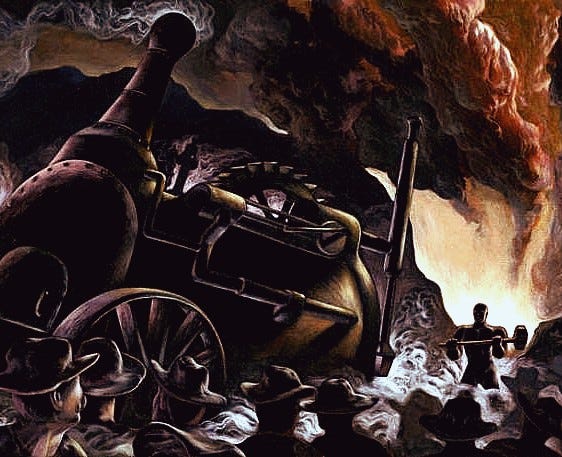
The Machine always sacrifices the human first. It promises wealth to a few and misery to the rest. As then, so today, the servants of the Machine say it is better and faster than man. It was there to deconstruct the human in the name of progress.
The human workers understood what this would mean. The workers got quiet. They knew what that meant. No more jobs. No more songs. The machine would take it all.
The Machine would take it all. Everything there that was human. No more authentically human things. The Machine seeks to take them all.
And so, John Henry challenged the Machine. “’I’ll race that steam drill,’ he said. ‘Me against the machine. Whoever drills the deepest hole wins.’ The stranger laughed. ‘A man against a steam drill? Son, you’re going to lose.’ John Henry didn’t laugh back. ‘Set it up.’
Me. Us against the Machine. The fancy strangers still say the same thing, “Son, you’re going to lose.”
And the feat began, man versus machine. The machine that was seeking to obliterate in the name of “efficiency” the good labor of man. John Henry would not let the Machine take his human labor away. And so the account goes on:
The whole railroad came to watch. Men lined up along the tunnel walls. Polly Ann stood at the front, holding their little boy. Even the birds in the trees seemed to be listening.
The stranger started up his steam drill. It hissed and clanked and started eating into the rock. Dust flew everywhere.
John Henry picked up a twenty-pound hammer in each hand. He nodded to his shaker. And then he began to swing.
Clang. Clang. Clang.
Faster and faster. His hammers blurred in the lamplight. Sparks shot from the steel. The other workers started singing his song to keep him going:
Before that steam drill shall beat me down,
I’ll die with my hammer in my hand!
An hour passed. Two hours. Three. The steam drill was smoking now, struggling to keep up. John Henry’s arms were like two pistons, never slowing, never resting.
Four hours. Five. The stranger’s face was getting red. His steam drill was breaking down. But John Henry just kept swinging.
Clang. Clang. Clang.
At the end of the sixth hour, the judges called time. They measured the two holes.
The steam drill had drilled nine feet.
John Henry had drilled fourteen.
The men roared. Polly Ann cried out and ran to him. John Henry stood there with a hammer in each hand, smiling the biggest smile of his whole life.
And then, slow and gentle, he sat down.
John Henry was not hammering for selfish reasons. He was not just hammering for just his own job. He was hammering for his wife and son. He hammered for his brothers and sisters, his fellow man. He was hammering for the songs. He was hammering for the sweat and blood of humanity. Man versus the machine.
There is something powerful in song. Song has been part of human existence for as long as we can remember. The Machine seeks to silence song. Today, it seeks to silence it by replacing it. The advanced machine, AI, makes anti-songs. It mimics human song and experience. There’s the rub: authentic song comes through experience, blood, sweat, labor, and love. These things the Machine can never know or understand. Today, the Machine seeks to silence human song through artificial song. As it said above, the Machine seeks to take it all. That is why AI is now seeking to replace all human activities, not just song, but art, writing, reading, talking, and so forth. This is not to help humanity but to degrade humanity.
And so let’s take up the human song, “Before that steam drill shall beat me down, I’ll die with a hammer in my hand!” Or to slightly alter it, our song is, “Before that Machine shall beat me down, I’ll die with a hammer in my hand!” John Henry knew it was better to die retaining his humanity than to live as a slave of the Machine.
He was the best steel-driving man, and he used his gift as a sacrifice to protect those he loved. In a very Christian way, he laid down his life for his friends. He gave with all his heart.
“Polly,” he said. “I’m awful tired.”
His wife held him close. The other men took off their hats.
John Henry had worked so hard, and swung so fast, that his big heart had given out. Just like he’d said when he was a baby.
He looked up at Polly Ann one last time and he smiled. “Bring me a cool drink of water,” he whispered.
And then John Henry, the greatest steel-driving man who ever lived, died right there with a hammer still in his hand.
John Henry lived and died a man. Today, our resistance to the Machine is principally the same: live and die as men. Authentic people doing authentically human things. John Henry is an American folklore hero. There will always be the soulless fancy men who want to destroy nature and humanity. It just takes the John Henrys of the day to stand against them. Fellow Americans, let’s find the John Henry in us. Those who are reading and are not from America, please feel free to join in too. I think John Henry is for anyone who resists the Machine. He’d be pleased if you sang his song.
Years went by. The steam drill broke down and got sold for scrap. But the song about John Henry kept going. Coal miners sang it. Railroad men sang it. Children sang it in schoolyards a hundred years after John Henry was gone.
And that’s why, they say, if you stand near an old railroad tunnel on a quiet night, you might hear a faint ringing sound. Clang. Clang. Clang. It isn’t just the wind. It’s John Henry, still swinging his hammer, still refusing to let a machine beat a man.
He died a long time ago. But his song is still going.
And that’s how you know he won.
Let’s take up that song that has waned over the years, the song of John Henry. The Machine doesn’t like it or want it to be sung. Let’s take up our hammers, however that manifests itself for us, and swing away while singing. Songs like his are what the Machine fears. John Henry, we’ll do the best we can to refuse to let the Machine beat man. Find your hammer, my friend, start swinging, and make a stand. Make John Henry proud.
“Before that Machine shall beat me down, I’ll die with a hammer in my hand!”
This! Yes!
Well done and well said!
Against the Machine changed my life, literally!
⛪ ☦️🕯️ Grace and peace to you Father, some wonderful Resources for the Feast Today:
https://www.johnsanidopoulos.com/2017/06/sunday-of-all-saints-resource-page.html
No one is saved alone, we never pray alone! ⚜️🌐🕊️